
Foreign Exchange Market or simply Forex is the world’s most traded market. It is a market where you exchange one currency to another at a predetermined rate, or foreign exchange rate.
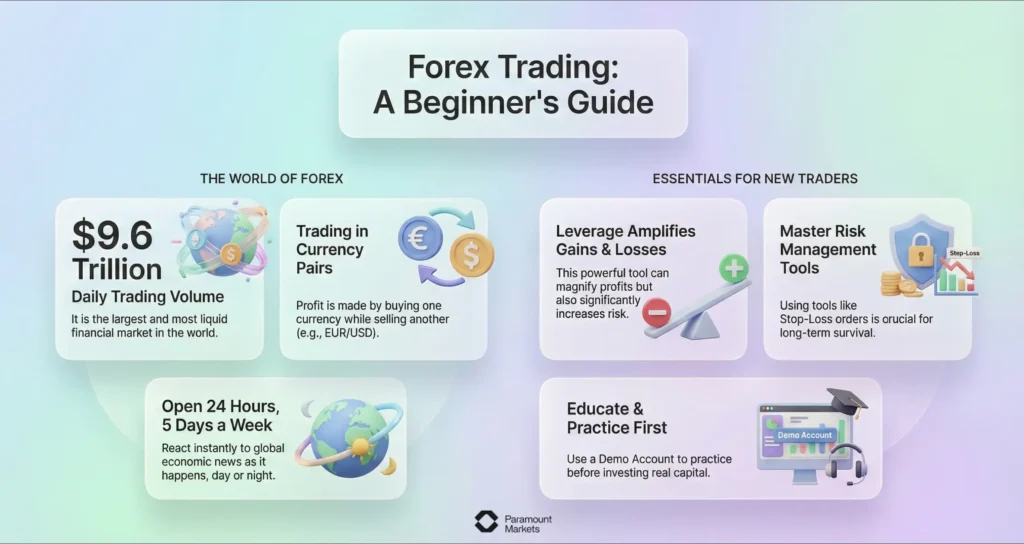
According to the Bank for International Settlements, the average daily trading volume in the Forex market hit $9.6 Trillion in 2025. The Forex market size is expected to surpass $1088.73 billion in 2029, making Foreign Exchange quite important in the global financial market.
If you are looking for a practically easy guide to learn what is forex, how it works, and why it is important enough to be mastered, this easy-to-understand guide is all you need to get started today.
What is Forex? Forex Market Explained
The Forex market, short for Foreign Exchange market, is essentially where currencies worldwide are traded.
Let me put it this way: imagine a giant, always-open bazaar, but instead of spices or textiles, the goods are money (various currencies) itself. That’s exactly the foreign exchange, or Forex(FX), market. It’s the world’s hub for trading currencies.
Let me break it down into its components to ensure you easily understand the concept:
The Forex Market Definition
FX market is a global marketplace for currencies, where they are traded for one another. It is the largest and most liquid market in the world. It is decentralized, meaning there is no physical location or exchange like the stock market. Forex differs from the stock market as it is electronic, which means 24/7 operations, five days a week, and that trading is global.
How Does The Market Function
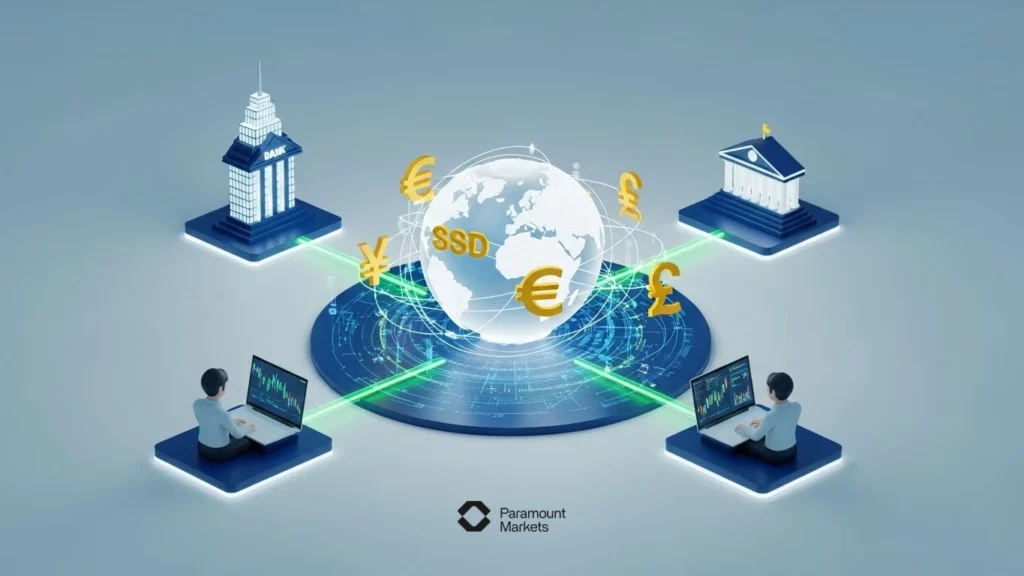
Currency markets operate by trading currencies in pairs like EUR/USD which represents Euro against US Dollar.
Forex trading involves making predictions about whether one currency will strengthen or weaken against another currency.
The market participants, or “Forex players”, as we call them, are banks, brokers, investment houses, corporations, governments, individual traders and other end users.
Imagine you live in the US and want to buy goods or services from Germany. You would first have to exchange your currency(the US Dollar) for the currency of Germany (Euros). This is how it is done, within the Forex market.
In addition, people trade on the forex market for profit. In other words, they hope to buy low and sell high, just like in any other market.
So, the main takeaway for the Forex Market function is that:
The Forex market facilitates global trade and finance by enabling international currency exchange.
The Importance of Understanding Forex
Before I explain the core concepts in detail, let me highlight the importance of learning the Forex market for beginners and explain why Forex (FX) matters to individual traders.
Economic Interconnectedness
The Forex market is one of the leading players in global economic interactions.
Significance of Market Size
While the total daily size of Forex trading reaches $7.5 trillion, the spot market (most relevant to traders) is around $2 trillion per day. This is a proof of how important the market is in the global financial system.
Profit Potential
Traders can make money in Forex trading by profiting from the changes in exchange rates between currencies. Beginner traders can make money by correctly predicting favourable rate movements by opening a Standard account with brokers like ParamountMarkets.
Economic Indicator
Economic factors and indicators significantly influence currency values, making the forex market dynamic and informative for traders. It is why the forex market serves as a real-time indicator of global economic health.
Pocket Glossary for Forex: Key Concepts in Forex Market

If you want to learn forex trading, first, you must know how to speak the market language. While I explain what is forex trading and the essentials to becoming a successful trader in the next few guides, below is a list of forex terms with simple examples for beginners.
Currency Pairs
- Base Currency: The first currency in a pair. For instance, in EUR/USD, EUR is the base currency worth 1 unit.
- Quote Currency: The second currency shows how much it takes to buy 1 unit of base. For example, if EUR/USD = 1.2000, it takes $1.20 to buy €1.
- Major Pairs: The most traded currency pairs, involving USD. EUR/USD, GBP/USD and USD/JPY rank as the highest traded major currency pairs.
- Cross Pairs: Currency pairs that do not include USD. For example, EUR/GBP, GBP/JPY.
Price Movement
- Pip or Percentage in Point: The standard smallest price move typically corresponds to the fourth decimal place. For example: EUR/USD moves from 1.2000 to 1.2001 = 1 pip.
- Pipette: Fifth decimal place movement. For example: From 1.20000 to 1.20001.
- Tick: Any price move up or down. For example, the price moving from 1.2000 to 1.2002.
Position Sizing
- Standard Lot: 100,000 units of base currency. For example: 1 standard lot EUR/USD = €100,000.
- Mini Lot: 10,000 units are mini lots, like 1 mini lot EUR/USD = €10,000
- Micro Lot: 1,000 units are micro lots. For example: 1 micro lot EUR/USD = €1,000.
Trading Costs
- Spread: Difference between buy and sell price. The concept is similar to the point spread in sports betting. For example: Buy at 1.2002, sell at 1.2000 = 2 pip spread.
- Commission: Broker fee per trade. For instance: $5 per $100,000 traded.
- Swap: Interest for holding positions overnight. For example: -$2 per night for holding short EUR/USD.
Risk Management
- Leverage: Borrowed money to control larger positions. For example, 1:100 means to control $100,000 with $1,000.
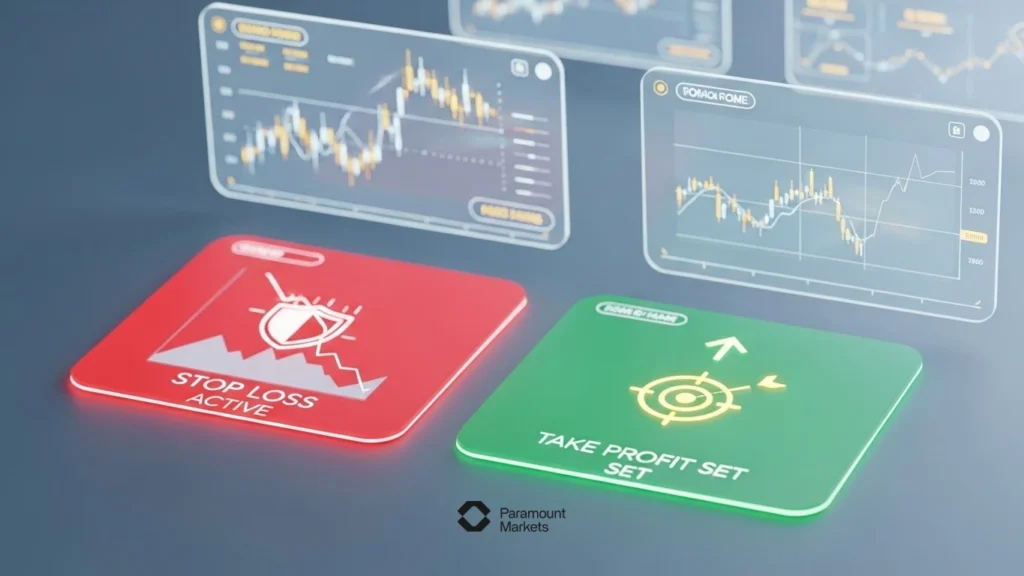
- Stop Loss: An order —an instruction to execute a trade at specific conditions— to limit potential losses. For instance: Selling EUR/USD at 1.2000, stop loss at 1.2020. This is one of the most important concepts in forex trading and involves various strategies which I will be discussing in separate forex trading guides. To start things easy and steady, you can read this stop-loss for novice traders to get a better overview.
- Take Profit: Order to secure profits. For example: Buying at 1.2000, take profit at 1.2050.
Market Conditions
- Volatility: Speed and size of price changes. For example: Price moving 100 pips in one hour.
- Liquidity: How easily something can be bought or sold without affecting its price. For example: Major currency pairs like EUR/USD have high liquidity and can absorb large trades in the millions of dollars without significantly impacting the price.
- Range: Price movement between high and low. For example: Daily range of 1.2000 to 1.2100.
Related Terms to Account
- Margin: The collateral required to open and maintain a leveraged position. For example: A 1% margin requirement means you need to deposit $1,000 to open a $100,000 position.
- Free Margin: The amount of equity in a trading account that is available to open new positions. For example: If your account balance is $10,000 and you have used $3,000 in margin, your free margin is $7,000.
- Equity: Current account value including open positions. For example: $10,000 balance + $500 floating profit = $10,500 equity.
Forex vs Stock Market: What are the Main Differences?
I put together a table highlighting the differences between Forex and the stock markets to give you a better overview of what is forex and how it differs from the old stock market we all know about.
| Feature | Forex Market | Stock Market |
|---|---|---|
| Trading Hours | 24 hours/day, 5 days/week | Fixed trading hours (typically 9:30 AM-4:00 PM) |
| Market Size | Larger, more liquid market | Smaller compared to Forex |
| What is Traded | Currency pairs | Company shares |
| Volatility | Generally more volatile | Usually less volatile |
| Influencing Factors | Economic indicators, political events, interest rates | Company performance, industry trends, market conditions |
| Additional Benefits | No dividends | Potential dividends and voting rights |
Who Trades Forex: Is Forex Trading Right for You?
The foreign exchange (FX) market is home to a wide variety of participants, including individual retail traders like you and me. In fact, retail traders make up approximately 5.5% of the Forex market and trade alongside banks, hedge funds, and corporations.
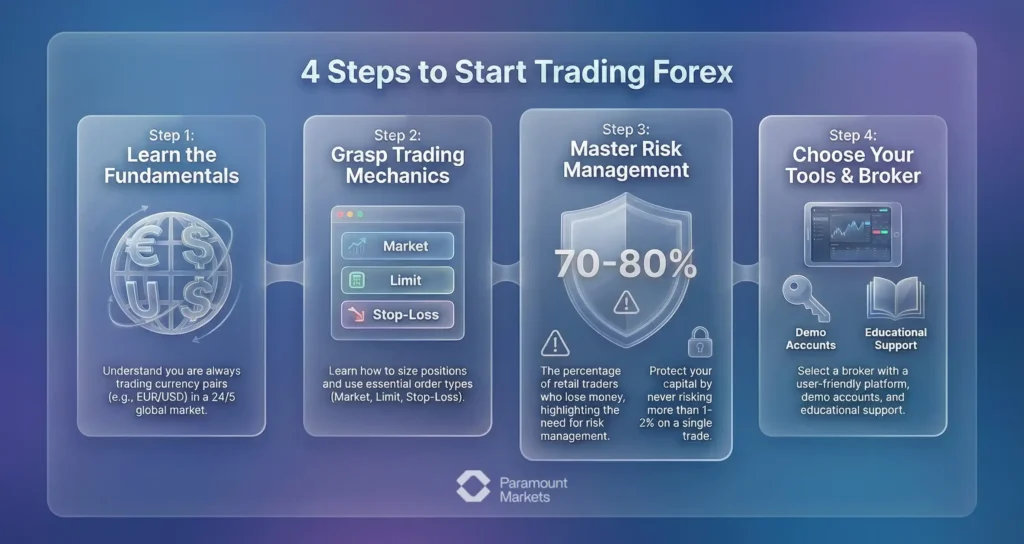
Forex trading can be suitable for anyone who has an interest in global economics, is comfortable with risk management, and has the time and patience to learn how to properly analyze the market. However, it is also important to note that approximately 70-80% of retail forex traders lose money, usually due to a lack of education and poor risk management.
So before you get started with your forex trading journey, make sure to get the proper education first. You can start with a demo account with a trusted broker such as ParamountMarkets, and keep in mind that successful trading requires patience and discipline.
How To Trade Forex: 4 Steps to Start Trading Forex
Forex trading or “currency trading” is simply the practice of trading—buying and selling—currencies to make a profit. The trading process takes place within the Forex market, which I explained in detail above. Below, I walk you through the essential concepts in forex trading to prepare you for more advanced concepts.
I cover how currency trading works and the detailed advanced strategies needed to generate a consistently profitable trade in other tutorials.
The following is a quick and practical to do list to help the new trader gain a better understanding of what and where they should be trading Forex.
Step 1: Understanding the Basics
The forex market has certain common concepts and rules that need to be understood in order to trade successfully. So, first of all, make sure you read the information above as well as information about the basic dynamic trading process.
- As you know from the previous information, while trading Forex, you always trade two currencies at the same time. For example, when trading EUR/USD, if you think that the Euro will strengthen against the US Dollar, then you buy EUR/USD. The point is that forex trading is all about pair currencies and their relationships. Each currency pair has a price that tells you how much of the quote currency you need to buy one unit of the base currency.
- The forex market is open 24 hours a day, five days a week, which means that trading is nonstop. The market trades electronically via networks and the world’s major financial centres of London, New York, Tokyo and Sydney dominate market activity during their respective trading sessions.
Step 2: Understanding Trading Mechanics
The forex market has unique mechanics which every newcomer should learn.
Position Sizing: Know how to size your positions in accordance with your account size and risk appetite. ParamountMarkets Broker offers flexible lot sizes, starting from micro-lots, which are perfect for beginners managing their risk.
Know your order types: Market Orders, Limit Orders, Stop-Loss Orders and Take-Profit Orders. If you are interested in doing some extra research about orders, I highly recommend reading the only book dedicated solely to the topic of order types in Forex: Stock Trading—Order Types by Bill Thompson.
Step 3: Master Risk Management
The high volatility and leverage in Forex can amplify both profits and losses. Risk management is crucial to protecting your capital from large and rapid drawdowns.
Without proper risk management, traders often succumb to emotional decision-making, which can exacerbate losses and jeopardize their long-term viability in the market.
Risk management is one of the most critical skills that you need to acquire to become a forex trader and earn actual profit.
Below are some of the most efficient forex risk management strategies:
- Capital Protection: Never risk more than 1-2% of your trading capital on a single trade. This conservative approach helps ensure longevity in the market and protects you from significant losses.
- Trading Plan Development: Develop a comprehensive trading plan, including entry rules, exit strategies, and risk parameters. Use the educational resources at your disposal, for example, ParamountMarkets Broker’s educational hub, to help you fine-tune your trading strategy.
- Diversification. Spread your risk over more than one currency pair.
- Risk/Reward Ratio. Know how much you could potentially earn on a trade relative to the amount you could lose.
- Use Stop-Loss orders. You can set a level at which a trade will automatically be closed once the loss reaches a certain point.
- Position Sizing. It is crucial to determine how much capital to invest in each trade, taking into account your overall risk tolerance and account size.
Step 4: Use Trading Tools & Advanced Trading Features
Just a reminder that success in forex trading comes with being well-educated and practising. Beginner forex traders can get the support they need from a trustworthy broker to help them understand the advanced features of the forex platform and to start and continue trading with confidence.
Checklist for selecting your broker:
- User-Friendly Platform.
- Variety of educational resources catering to beginners and pro traders.
- Access to demo accounts.
- Reliable and responsive customer support. Remember, many forex frauds happen on social media. You should avoid people who approach you through social media and dating apps, messaging apps, or unsolicited emails and want to discuss forex trading on behalf of a broker or independent dealer. Avoid WhatsApp customer service numbers.
- Offering account types suitable for beginners.
- Access to copy trading for beginners.
Start Your Forex Journey at ParamountMarkets Broker
The key to becoming a successful trader in the forex market is choosing the right broker. While the right broker depends on your personal preferences, ParamountMarkets is the ideal choice for beginner and advanced traders because of its reliability, super user-friendly platform, no hidden fees, high level of transparency, competitive prices, and more. Do not miss the big opportunity and sign up today.
Last Few Words
Forex (FX) is a world of opportunity for those willing to make the plunge and learn how to trade the currency pairs in the global marketplace. Understanding the basics, using the right tools, and following good risk management can help a trader make it through the trials and tribulations that come with trading.
One last reminder, never stop learning and practising. Our educational resources will show you what is forex and our website has lots more beginner’s guides so you can become a currency trading pro.
Take the next step on your forex and currency trading journey and open an account with ParamountMarkets to access a reliable platform, educational resources and customer support that will help you achieve your trading goals.
FAQ
Is forex trading legal?
Yes, forex trading is legal in many countries, including the United States and Europe. However, it’s important to understand that the legality and regulation of forex trading can vary significantly from one jurisdiction to another.
How do you make money in forex?
By buying a currency at one price and selling it at a higher price (or selling high and buying low).
Is forex risky?
Yes, while Forex is highly volatile and carries inherent risks, proper education and risk management strategies can significantly lower risks and prevent losses.
What is a broker?
A broker provides access to the forex market and executes your trades.
Should I use a demo account first?
Absolutely! Practice with a demo account before trading real money.
Disclaimer: The information provided in this article is for educational and informational purposes only and does not constitute financial advice, investment recommendations, or an offer to buy or sell any financial instruments. Trading Foreign Exchange (Forex) and Contracts for Difference (CFDs) involves a high level of risk and may not be suitable for all investors. Leverage can work against you as well as for you. Before deciding to trade, you should carefully consider your investment objectives, level of experience, and risk appetite. You should not invest money that you cannot afford to lose.
